

Kaizen Cases
Improving On-Time Delivery Through the Rigorous Implementation of Daily Management and Standard Work
This case describes a structural improvement in On-Time Delivery (OTD) achieved through a series of Shingijutsu Kaizen Workshops (SKW). Despite fluctuations in demand and external disruptions, the plant progressively implemented the workshops and fundamentally redesigned its Daily Management system.
Background and Problem Recognition
At this site, as Units Shipped increased, OTD remained unstable and the 95% target could not be consistently achieved. In addition, external factors such as increased holidays and a hurricane further exposed shipment delays.
However, the essence of the problem was not simply higher demand or natural disasters.
A close observation of the shop floor revealed the following structural issues:
- Daily equipment checks had become routine and superficial
- Abnormalities were not detected at an early stage
- Daily progress was not visualized
- Standard Work had become nominal and was no longer actively managed
In other words, declining OTD was a “result”. The root cause lay in insufficient Daily Management and the lack of rigor in Standard Work execution.
Approach: Rebuilding Daily Management
The first step was the visualization of Daily Maintenance.
Rather than asking whether inspections had been completed, the system was redesigned from the perspective of whether abnormalities could be recognized immediately. The Daily Maintenance Check Sheet was rebuilt to reflect actual shop floor conditions. By incorporating photographs and clearly defined criteria, variability in judgment was eliminated.
In parallel, a Daily Management Board was introduced to visualize the following on a daily basis:
- Daily plan versus actual performance
- Shipment progress
- Status of abnormalities
- Corrective actions
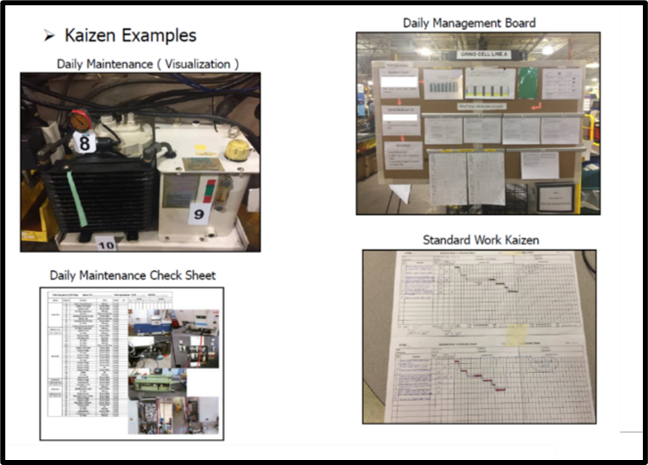
The key was not the physical board itself, but the mechanism for daily review and dialogue. Management was embedded into daily routines rather than treated as an occasional event.
Implementation of Standard Work Kaizen
The next step was the improvement of Standard Work.
Current operations were analyzed along a time axis, and work elements were broken down. After visualizing waste, variation, and overburden, the processes were redesigned based on takt time.
Using the Standard Work Combination Sheet, the team clarified:
- Manual work time
- Machine time
- Walking and waiting time
Imbalances between processes were corrected, and overall flow was improved.
The objective was not merely to enforce compliance with standards.
It was to build a culture in which improved standards are created and continuously updated by the people performing the work.
Results: Structural Improvement in OTD
OTD, which had initially been in the 60% range, was improved steadily toward the 95% target through six workshops conducted over a period of one year and eight months.
Even under increased demand and external disruptions such as natural disasters, the operation became resilient and no longer experienced severe performance breakdowns.
This was not simply a numerical improvement.
- A workplace capable of immediately detecting abnormalities
- A system that shares daily progress transparently
- Standards that are actively maintained and continuously improved
In other words, the organization evolved into one that can manage issues before they escalate.
Practical Implications
The implications of this case are clear.
OTD is not merely a logistics issue.
It stabilizes only when the fundamentals—Equipment Maintenance, Standard Work, and Daily Management—are properly established.
Sustainable results require more than short-term, event-driven improvements. They require structured design, phased implementation, and disciplined sustainment through repeated workshops.
Daily Management and Standard Work are not extraordinary initiatives.
However, when they are rebuilt with seriousness and discipline, the operational foundation of an organization changes decisively.