

Kaizen Cases
Reducing Patient Lead Time
— Improving Healthcare Flow through the POD (Point of Delivery) System —
In healthcare institutions, patient waiting time is one of the key indicators that directly affects service quality. In outpatient care in particular, multiple activities—such as consultation, testing, and nursing support—must be coordinated. When the operational design is not well structured, patient lead time tends to increase.
This case introduces a Kaizen initiative that reduced patient lead time by redesigning the work flow and responsibility areas of doctors and nurses based on the concept of the POD (Point of Delivery) system.
Background and Challenges
At the U.S. hospital examined in this case, multiple examination rooms were available, and doctors and nurses were responsible for several rooms simultaneously.
Although this arrangement appeared flexible, several operational problems became apparent in practice:
- Doctors and nurses frequently moved between multiple rooms, resulting in long walking distances
- Room setup and preparation had to be repeated each time staff moved between rooms
- The sequence of patient consultations became inconsistent, leading to increased waiting times
- Staff movement patterns became complex, making operational visibility and management difficult
In other words, the issue of patient waiting time was not simply a matter of insufficient clinical capacity. Rather, it was a structural issue rooted in the design of the workflow itself.
Improvement Approach
Introduction of the POD (Point of Delivery) System
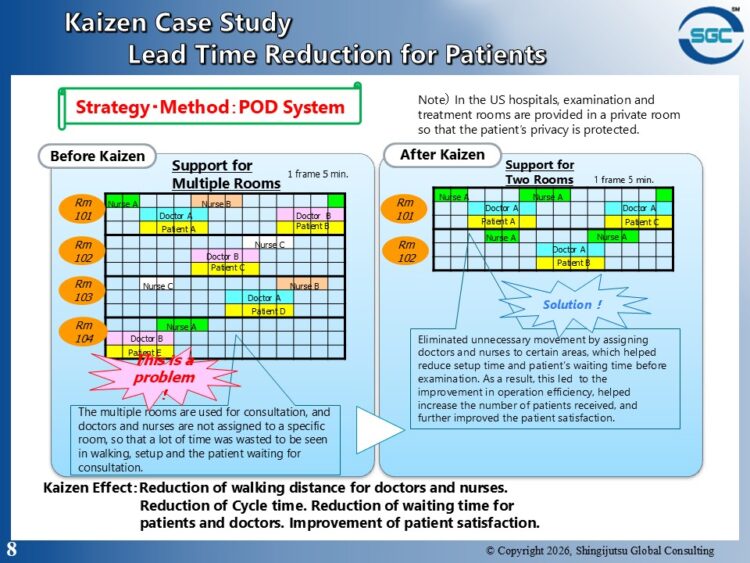
The key improvement was assigning fixed responsibility areas to doctors and nurses.
Instead of moving across multiple rooms as before, the hospital reorganized the system by assigning two examination rooms as one operational unit, thereby redesigning staff movement and simplifying workflow.
This change made it possible to:
- Minimize staff movement
- Standardize room preparation and setup activities
- Operate patient flow in a stable and predictable cycle
From a Lean perspective, this improvement corresponds to the reduction of Motion waste and the improvement of operational flow.
Results of the Improvement
After introducing the POD system, the hospital achieved several measurable improvements:
- Significant reduction in walking distance for doctors and nurses
- Shorter clinical cycle times
- Reduced patient waiting times
- Improved patient satisfaction
In healthcare settings, improvement initiatives often focus on facility investment or IT implementation. However, this case demonstrates that substantial improvements can be achieved simply by redesigning workflow and staff movement.
Key Takeaways
This case provides valuable insights not only for healthcare organizations but also for many service industries.
The essential point is not merely improving individual task efficiency, but designing the overall flow around the patient (the customer).
From a Lean perspective, any movement, waiting, or preparation that does not create value should be considered an opportunity for improvement. In that sense, this case represents a practical application of Lean Thinking in healthcare services.
By redesigning operations, it is possible to reduce patient waiting time while simultaneously improving the working conditions of healthcare staff.
This is the essence of Kaizen.