

News &
Column
A Book That Portrays Corporate Turnaround Through Design and Execution
Book Review
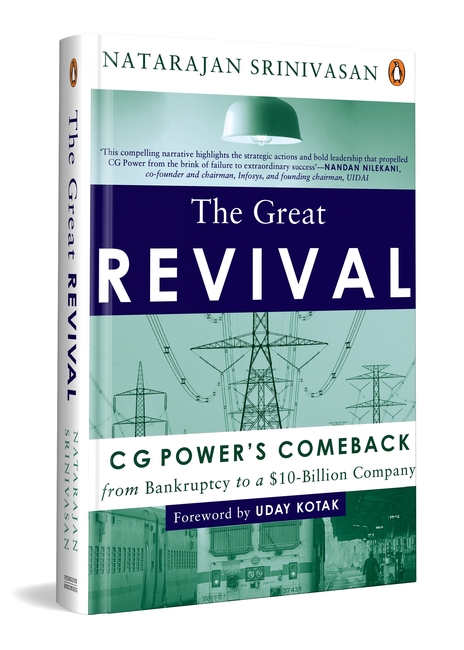
The Great Revival
CG Power’s Comeback from Bankruptcy to a $10 Billion Company
By Natarajan Srinivasan
A Book That Portrays Corporate Turnaround Through Design and Execution
The Great Revival documents how CG Power, one of India’s leading electrical equipment manufacturers, recovered from a situation close to bankruptcy and returned to a sustainable growth trajectory. Rather than presenting a simple success story or relying on abstract management philosophy, the book’s strength lies in its clear articulation of how the turnaround was architected as an integrated design and executed in a deliberate sequence, viewed squarely from a management perspective.
While the book as a whole focuses primarily on governance, financial credibility, asset restructuring, and procurement reform, one chapter in particular offers important insights for manufacturing organizations: Chapter 6, “Multi-Pronged Turnaround Approach.”
What Chapter 6 Reveals About the Role of Operational Transformation
Chapter 6 makes it clear that CG Power’s recovery was not driven by a single breakthrough initiative. Instead, it was conceived and executed as a Multi-Pronged Turnaround, in which multiple levers were activated in parallel. Alongside finance, assets, procurement, and governance, manufacturing operations were positioned as a core pillar of the overall recovery strategy, not as a secondary or tactical activity.
Within this context, the book introduces Lean, rooted in the Toyota Production System (TPS), as the guiding philosophy for operational transformation. Importantly, SGC (Shingijutsu Global Consulting) appears not as a conventional external advisor, but as the partner responsible for embedding Lean thinking across CG Power’s manufacturing footprint.
SGC’s role is portrayed as one of shaping mindset and execution capability—helping Lean take root as a way of thinking rather than a set of isolated improvement tools.
Lean as a Management Foundation, Not an Improvement Technique
A defining feature of the narrative in Chapter 6 is that Lean is never reduced to productivity improvement or cost-cutting techniques. Instead, Lean is presented as a disciplined way of asking fundamental questions about work and organization, such as:
- Does this activity truly create value for the customer?
- Is the process designed in the correct sequence and flow?
- Are abnormalities visible, and can the organization stop and respond immediately when they occur?
These questions are directly connected to core TPS principles such as Just-in-Time and Jidoka, underscoring the treatment of Lean as a management philosophy, not merely a shop-floor initiative.
SGC’s involvement is described not through a list of numerical results or isolated success stories, but through its role in supporting the cultural embedment of Lean—ensuring that improvement capability remained within the organization long after individual interventions.
Designing Improvement for Sustainability, Not One-Time Gains
One of the key lessons from Chapter 6 is that the success or failure of Kaizen does not hinge on the sophistication of individual tools. Rather, it depends on the overall system design that supports improvement and the consistency of management intent.
At CG Power, the turnaround was designed so that:
- Financial restructuring
- Structural reform of procurement
- Redesign of manufacturing operations
reinforced one another. Lean functioned not as a collection of localized optimizations, but as the operational foundation enabling sustainable forward momentum across the enterprise.
This perspective offers practical insight for organizations struggling with familiar challenges such as “improvements that do not stick” or “results that fade over time.”
Closing Thoughts
The Great Revival is not a book of factory-level Kaizen case studies. However, the way Lean and TPS are positioned in Chapter 6 makes it highly relevant for organizations seeking to place improvement at the heart of business strategy.
By framing Kaizen not as a localized activity but as an integral element of corporate renewal and competitiveness, the book provides thoughtful and practical guidance on how improvement should be designed, implemented, and sustained. It is a quietly compelling read for leaders and practitioners who view operational excellence as a strategic capability rather than a tactical exercise.