

News &
Column
What Is Kaizen?
— Understanding Kaizen as an Integrated Practice of Waste Elimination, Company Growth, and Human Development —
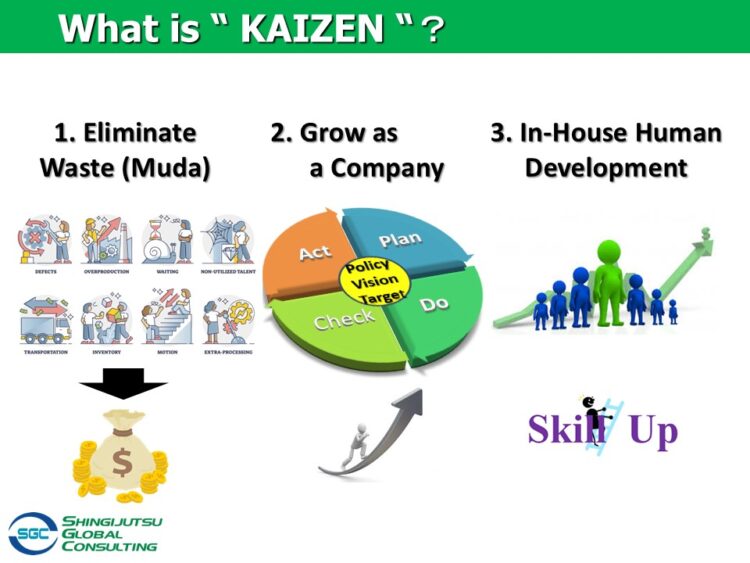
Kaizen activities are often understood in narrow terms, such as cost reduction or shopfloor-level ingenuity. In practice, however, the essence of Kaizen is far broader. Kaizen is the disciplined practice of rethinking how work is done, reducing activities that do not create value, and continuously building better operating systems across the business.
To introduce this concept more clearly, we have published a YouTube video titled “What is ‘KAIZEN’?” The video presents Kaizen not simply as a form of operational improvement, but as an integrated practice built on three perspectives: waste elimination, company growth, and in-house human development. For readers who would like a concise introduction first, we invite you to watch the video below.
YouTube: https://youtu.be/IV8KBvubfmI
Although the term Kaizen is widely recognized, its meaning is still often interpreted too narrowly in business practice. Activities such as 5S, layout changes, or labor reduction are sometimes treated as Kaizen in themselves. However, Kaizen is more than a collection of isolated improvement actions. At its core, it is a management practice that strengthens competitiveness through operational improvement while developing people at the same time. In this sense, the shop floor and management should not be treated as separate domains. They must function in alignment.
The first pillar is waste elimination. In the context of Lean and the Toyota Production System, Waste (Muda) does not simply refer to excess cost. It includes all activities that do not contribute to customer value, including defects, overproduction, waiting, transport, inventory, motion, over-processing, and the underutilization of people’s capabilities. Problems in operations often appear as individual incidents, but behind them are structural causes such as poor flow, overproduction, inadequate setup, unclear Standard Work, and weak information linkage.
For that reason, the starting point of Kaizen is not to react to visible symptoms alone, but to understand the current state accurately. Actual work, information flow, stoppages, rework, and variation must be observed carefully so that the true barriers to value creation can be identified across the entire Value Stream. The objective of Kaizen is not reduction alone, but to create value. It is to create work processes in which flow is smoother, abnormalities are easier to detect, and action can be taken earlier. As a result, improvements can be realized in quality, delivery, productivity, inventory, and profitability.
The second pillar is company growth. Whether improvement efforts truly generate sustainable results depends on whether they are connected to management direction. When shopfloor improvement remains a collection of local initiatives disconnected from business goals, the activity becomes fragmented and difficult to sustain. By contrast, when Policy, Vision, and Target are clearly defined and translated into concrete operational priorities, Kaizen becomes a driver of business growth.
This is where the practical use of PDCA becomes essential. However, it is not enough to run PDCA as a formal management routine. In the Plan phase, the gap between the target and the current condition must be made explicit. In the Do phase, changes must be tested in the actual workplace. In the Check phase, not only the outcome but also the validity of the process must be examined. In the Act phase, what has been learned must be standardized or used to initiate the next cycle of improvement. Only when this cycle functions continuously does improvement move beyond a one-time event and become part of the company’s growth capability.
From a management standpoint, outcomes such as revenue growth, margin improvement, delivery performance, and quality stability ultimately depend on the quality of operational design at the workplace. Kaizen, therefore, is not a shopfloor issue alone. It is a management issue. Sustainable results become possible only when the direction set by management is aligned with the themes being addressed in day-to-day operations.
The third pillar is human development. Kaizen is not only a mechanism for producing results; it is also a mechanism for developing capability within the organization. In companies where improvement does not take root, the problem is often not a lack of tools or knowledge. More often, the organization has not yet developed enough people who can identify problems, think based on facts, test countermeasures, and translate learning into standards. By contrast, when supervisors and operational leaders understand Standard Work, recognize abnormalities, and support structured improvement, Kaizen begins to accumulate as organizational capability.
People development in this context does not mean classroom training alone. It means learning through actual work, in actual workplaces, by addressing real problems. The ability to see waste, distinguish symptoms from causes, design measures that prevent recurrence, follow standards, and revise them when necessary—these are practical capabilities developed through the process of improvement itself. In organizations with strong Kaizen capability, improvement leads not only to better performance but also to the development of people who can lead the next cycle of improvement. This creates a reinforcing cycle between results and capability.
Seen in this way, Kaizen is not merely an activity for eliminating waste, nor is it simply policy deployment or employee training. It is a practice of continuously improving the way work is designed and managed by integrating waste elimination, business growth, and people development. If one of these elements is emphasized in isolation, improvement tends to become partial and unsustainable. A narrow focus on cost reduction alone can exhaust the organization. A focus on policy without execution creates distance from reality. A focus on development without business impact weakens continuity. That is why Kaizen must be designed and operated as an integrated system.
In implementation, the starting point is always an accurate understanding of the current condition. From there, priority themes aligned with business goals must be defined, tested on a manageable scale, reviewed, and standardized. Through this repetition, improvement evolves from a standalone initiative into part of daily management. In addition, if results are evaluated not only in terms of metrics but also in terms of problem-recognition capability on the shop floor and the development of management capability, Kaizen can be transformed into a sustainable organizational strength.
Our YouTube video, “What is ‘KAIZEN’?”, presents these foundational perspectives in a concise and visual format. This article expands on those ideas in a more practical business context, offering management, Kaizen leaders, and operational transformation practitioners a framework for thinking about how Kaizen should be designed and how it can be sustained.
Watch the video here:
https://youtu.be/IV8KBvubfmI
Kaizen is not simply an improvement technique. It is a disciplined practice through which companies redesign how value is created, strengthen competitiveness, and grow by developing people at the same time. When improvement is embedded not as a one-time initiative but as a shared language between management and the workplace, Kaizen becomes a foundation for business transformation.